Thursday, April 07, 2016

Turkey Seizes Six Churches as State Property in Volatile Southeast

After 10 months of urban conflict in Turkey's war-torn southeast, the government has expropriated huge sections of property, apparently to rebuild and restore the historical centre of the region's largest city, Diyarbakir.

But to the dismay of the city's handful of Christian congregations, this includes all its Orthodox, Catholic and Protestant churches. Unlike the state-funded mosques, Turkey's ancient church buildings - some of which pre-date Islam - have been managed, historically, by church foundations.

The new decision has effectively made the Diyarbakir churches - one 1,700 years old, another built only in 2003 - state property of Turkey, an Islamic country of 75 million.
Link

Reacting to the News from Turkey

In recent days, the news from Turkey seems to be producing the wrong kind of headlines.
  • Bombings in Ankara, Istanbul, and Diyarbakir
  • Attacks on personal freedoms and freedom of the press
  • Threats against minorities and their properties
  • Dark tales of loss of refugee life and abuse of displaced peoples
In light of news like this, what should our response be? Many countries have begun issuing travel advisories, telling their citizens to stay home. Parts of the city, which were once crowded with tourists are now empty except for small groups and a high police presence. Sharp declines have occurred in visitors from Europe, Russia and the United States. Many cruise lines have cancelled their stops in the ports of Turkey.

Link

Tuesday, March 22, 2016

How Istanbul's districts got their names?

There are various rumors and stories on how Istanbul's popular districts got their names. These stories are not only worth-reading but also relect the city's multi-cultural history


Link

Tuesday, February 02, 2016

Fierce battles in southeast Turkey hedge in Christians

One of the oldest churches in the world sustained damage last week in the intensified fighting between the Turkish government and Kurdish separatists.
Rocket-propelled grenades destroyed a portion of the wall surrounding the Virgin Mary Church in the southeastern city of Diyarbakir on 28 Jan. The Syriac Orthodox church is 1,700 years old.

Fr. Yusuf Akbulut, the priest of the church, was sheltered with his family at his home located on church grounds during the attack.
Violence has engulfed Diyarbakir's Sur district, the location of the church, since early December. The government issued an evacuation order 26 Jan. due to pitched street battles between armed militants from the Kurdistan Workers' Party (PKK) and Turkish forces.
Akbulut, who has overseen the church for 23 years, initially refused to evacuate. He and his wife remained in the building until 28 Jan., saying he feared the church would be leveled in an aerial bombardment if left empty.
“We wouldn't have left the church. But when we looked [on the street] and saw that land mines and rockets were exploding non-stop, we knew that we couldn't stay,” he told World Watch Monitor. “Our house was shaking and we thought it would collapse.”
The power, electricity, and water were cut off. It was time to flee.
Akbulut dialed 155, the police emergency line. He was told that his neighborhood was a no-go area, barricaded off to civil authorities. The operator gave him instructions on how to escape. They stepped out on the street cautiously, with Akbulut waving a white flag. Nobody was there.
Whole buildings were collapsed, reduced to piles of rubble. "It was like a war zone,” he said.

Monday, February 01, 2016

Turkish textbooks encourage intolerance

A report by the U.S. Commission on International Religious Freedom has found that Turkey's textbooks encourage intolerance towards non-Islamic religions while reinforcing negative stereotypes.
According to Barnabas Aid, the report reveals that Turkey's religious ed textbooks teach students only what Islam believes about Judaism and Christianity and not what Jews and Christians themselves believe.
(Worthy News) - Theoretically, Turkey allows non-Muslims to be exempted from compulsory religious education if their religion is on record with the state. But parents have complained that some schools have refused to allow their children to be exempted.

Turkey: Christian Refugees Live in Fear


Around 45,000 Armenian and Assyrian Christians (also known as Syriac and Chaldean) who fled Syria and Iraq and have settled in small Anatolian cities in Turkey, are forced to hide their religious identity, according to the Hurriyet daily newspaper.

Since the Islamic State (ISIS) invaded Iraqi and Syrian cities, Christians and Yazidis have become the group's main target, facing another possible genocide at the hands of Muslims.

Anonis Alis Salciyan, an Armenian who fled Iraq for Turkey, told Hurriyet that in public, they pretend to be Muslim.

"My husband and I fled [Iraq] with our two children one year ago with around 20 other families. There was pressure on us in Iraq," Salciyan said, recalling that her husband, who ran a jewelry shop in Iraq, is now unemployed. "We have relatives in Europe. Only thanks to their support are we getting by. Our children cannot go to school here; they cannot speak Turkish."

What makes the plight of Christian refugees in Turkey even more tragic is that the ancestors of some of those refugees were driven out of Anatolia by the Ottoman authorities and local Muslims a century ago, during what are known as the Armenian Genocide and Assyrian Genocide of 1915.

Another family, Linda and Vahan Markaryan, also fled to Turkey with their two children. Their home in Baghdad had been raided by ISIS jihadists.

"My daughter, Nuşik, seven, stopped talking that day. She has not spoken since. We are working hard to provide her treatment, but she still will not speak," Linda Markaryan said, adding that it was hard for them to practice their religion. "We have to conduct our prayers at home."

Islamic jihadist armies invaded Middle Eastern and North African lands starting in the 7th century. The indigenous, non-Muslim, peoples of those lands have doubtless forgotten what safety, security and religious freedom mean.

In every country that is now majority-Muslim, there are horror stories of violent subjugation, rapes, slavery and murder of the non-Muslim people at the hands of jihadists.

Christians have existed in Syria since the earliest days of Christianity; today, after the raids of ISIS, they are fleeing for their lives.

Turkish Court Rules Government Failed to Protect Christians Killed in Malatya

A Turkish court ruled on Tuesday (Jan. 26) that the government was negligent in its duty to protect three Christians who were tortured and killed in 2007 and ordered it to pay damages to the victims’ families.
The Malatya Administrative Court ruled that, nearly nine years ago, the Interior Ministry and the Malatya Governor’s Office ignored reliable intelligence that Turkish nationalists were targeting the three Christians days prior to the April 2007 killings.
Five young men with alleged links to Turkish nationalists killed three Christians on April 18, 2007, in the office of the Zirve Publishing House in Malatya in southeastern Turkey. Ugur Yüksel, 32, and Necati Aydin, 36, both Turkish converts from Islam, and Tilmann Geske, 45, a German national, were bound, interrogated about their Christian activities and then mutilated and killed with knives, according to court evidence.
According to several Christians close to the victims, one or more of those accused of the killings cultivated relationships with the three Christians, one even going so far as to pose as a new convert to the Christian faith.
The court also ordered the Interior Ministry to pay the families close to 1 million Turkish lira ($333,980) in damages.

Susanne Geske, Tilmann’s widow, and her three children were awarded $105,000 for emotional distress and $5,500 for physical harm. The remainder of the damages were awarded to Aydin’s wife and Yüksel’s father.
Geske said Wednesday that the concept of a monetary award for the death of her husband and her children’s father is lost on her, as no amount of money will bring him back or fill their loss.
“Four-hundred thousand lira for someone being killed is baffling, funny,” she said. “And anyway, although the money is welcome, we’re not yet believing we will see the money.”
Geske said government appeals to the court-ordered award, if filed, could take years to settle. After taxes, civil fees and lawyer’s fees are assigned, the amount her family receives could be greatly reduced.
The Geske family filed its civil case with others in 2008, around the same time criminal proceedings began against the five men accused in the killing. The civil ruling offers some resolution, but the criminal case grinds on with little hope of resolution.

Sunday, September 06, 2015

Death threats target Turkey's Protestants

Fifteen Turkish Protestant congregations and their leaders have been targeted since 27 Aug. by a strident campaign of death threats sent to their Facebook, email, websites and mobile telephones.
The threats followed the style and jargon typically used by the so-called Islamic State (IS), vowing to kill, massacre and behead apostates who the messages accused of having “chosen the path that denies Allah” and “dragged others into believing as you do… As heretics you have increased your numbers with ignorant followers”.
“Threats are not anything new for the Protestant community who live in this country and want to raise their children here,” the Association of Protestant Christians in Turkey said in a press release on 1 Sept. “But with the recent increase in systematic threats, from this country’s west to east and north to south, in different cities, we think that these messages, coming close together and resembling each other, are coming from the same source.”
A copy of one message seen by World Watch Monitor displayed the IS flag and called itself “those who go to jihad”. It warned: “Perverted infidels, the time that we will strike your necks is soon. May Allah receive the glory and praise.”
Most of the messages included a direct quote from the Al-Ahzab chapter of the Quran, which threatens “those who spread false news… Accursed, they shall be seized wherever found and killed with a horrible slaughter.”
A link was also posted for an Arabic video subtitled in Turkish on YouTube entitled, “The religious proofs why apostates should be killed”.
One pastor attacked over both email and SMS messages told World Watch Monitor, “They are saying things like they had been waiting for us to return to Islam, and that we are responsible for other Muslims turning to Christ, that our time is up and that Allah will give them our heads”.
The majority of Turkish Protestant congregations are former Muslims who have converted to Christianity. In contrast to most Muslim-majority nations, Turkish citizens have the legal right to change their religious identity or leave blank the religion column on their IDs.
Church leaders who received the messages were encouraged by the association to notify the police and public prosecutors in their local area regarding the threats.

Tuesday, June 16, 2015

Man sets Orthodox church on fire in Istanbul with Molotov cocktail

An unidentified man set Aya Triada Orthodox Church on fire in Istanbul's Kadıköy district on late Tuesday evening with a Molotov cocktail. Below is a video taken by a bystander showing the man setting fire to the church. Details of the incident were not clear, the man was detained by police shortly after and the fire was quickly extinguished. The man in the video is heard saying, 'I will revenge the al-Aqsa mosque'.
The next day, hundreds of protesters marched against this attack, demonstrating solidarity with Christians and other oppressed groups.  

Wednesday, June 10, 2015

Turkey’s Christian minority sends four deputies to parliament

Turkey’s Christian minority will be represented in the Turkish parliament in greater number after a long absence as four members of the community will become deputies after the June 7 elections. 

The results of the parliamentary election, one of the most critical and closely fought in years, ended the Justice and Development Party’s (AKP) 13-year one-party rule, while also propelling four members of the Christian minority to the legislature.

Markar Esayan, an Armenian-Turkish journalist for the pro-AKP daily Yeni Şafak, entered the parliament on an AKP ticket as the 12th candidate from Istanbul’s second election area.

Selina Doğan, from the Republican People’s Party (CHP), was elected as the first deputy candidate from the second election area of the CHP’s Istanbul list. Doğan, who is of Armenian origin, practices law as an attorney.

CHP head Kemal Kılıçdaroğlu said while introducing Doğan as a candidate that her candidacy was an important message for the world.

“We do not want division in this society. We want to grow and develop together,” Kılıçdaroğlu said in early April.

Two Christians will also enter parliament from the Peoples’ Democratic Party (HDP) ticket, one from Istanbul and the other from the southeastern province of Mardin.

Garo Paylan, who ran for parliament as the second nominee from the HDP’s third election area in Istanbul, holds Armenian roots and is listed as a trainer on the Supreme Election Board (YSK) candidate list.

Erol Dora, who is a member of Turkey’s Syriac community and a lawyer, was the HDP’s third deputy candidate from Mardin and an incumbent in the legislature.

Tuesday, May 26, 2015

Turkish Mall Scraps Plans for Jewish, Christian Prayer Rooms After ‘Attacks’

A recently opened furniture mall in western Turkey scrapped plans to open separate prayer rooms for Jews and Christians over a series of “intolerant attacks,” Turkey’s Hurriyet newspaper reported on Friday.
Haluk Ozbek, founder of the Mobiliyum AVM furniture emporium in the Inegol district about 155 miles south of Istanbul, said original plans sought to make the mall a global attraction.
“But we have been subject to ugly and incomprehensible attacks” over the inclusion of Christian and Jewish worship rooms, in addition to the mosque that was constructed.
“Mobiliyum AVM has been exposed to ugly attacks via the media as well as by action. We have decided to reverse our decision to open prayer rooms, as we have lacked support from democratic circles against these attacks,” said Ozbek, in a statement published by Hurriyet.
He also told the newspaper that the attacks were caused by a lack of tolerance.

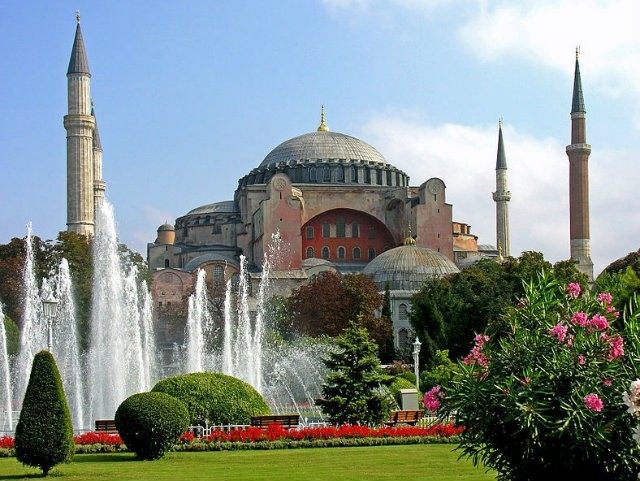
MUSLIMS DEMAND TURKEY CONVERT HAGIA SOPHIA INTO MOSQUE


A large rally in Istanbul demanded the government change the historic Hagia Sophia church, a UNESCO World Heritage Site, into a mosque. The Humanitarian Relief Foundation (İHH) led the rally through the Sultanahmet district.
Many people carried signs that said, “Hagia Sophia needs to be reopened as a mosque” and “Let our lives be sacrificed for Islam.”
The idea to change the church into a mosque begun to gain momentum in April after Pope Francis recognized the slaying of 1.5 million Armenians as genocide. Liam Deacon at Breitbart London chronicled the history of Hagia Sophia. The Ottoman Empire did convert the church into a mosque in 1453. After the empire fell, the new Turkish government transformed it into a secular museum.
“Frankly, I believe that the Pope’s remarks will only accelerate the process for Hagia Sophia to be reopened for [Muslim] worship,” Professor Hizli, a senior government cleric,said in a written statement on April 15th.
He decried the Pope’s comments as a “modern reflection of the crusader wars launched in these lands for centuries,” and suggested that Turkey’s role as a “standard bearer” for the Muslim world provoked criticism from non-Muslims.
The latest blow was using the church to celebrate Islam during Easter holy week.
“The historic Istanbul cathedral and museum, Hagia Sophia, witnessed its first Quran recitation under its roof after 85 years Saturday,” reported the Anatolian News Agency of Turkey. “The Religious Affairs Directorate launched the exhibition ‘Love of Prophet,’ as part of commemorations of the birth of Islamic Prophet Muhammad.”

Friday, May 22, 2015

Church Plant in Turkey Seeks to Sidestep Dangers

First century churches in what is now modern Turkey met mostly in homes, but Christians in the country today find they run more risks meeting in their living space than in public buildings.
A Turkish pastor said Christians in towns along the Black Sea coast cannot meet in their apartments without raising suspicions from Muslim neighbors. In Samsun, in what was once the Roman province of Pontus to which the Apostle Peter addressed believers in 1 Peter 1:1, Pastor Matta (full name withheld for security reasons) and a colleague planted a church 13 years ago as they were simultaneously seeking to plant churches in Ordu and other towns along the Black Sea coast.
When they began making trips to Ordu, 93 miles east of Samsun, to disciple former Muslims, Pastor Matta and a colleague initially ministered primarily in parks. Turks are highly relational, conversational and hospitable, Pastor Matta said, but the same relational bent that opens opportunities for gospel proclamation also makes it hard for those who have embraced Christ to meet for worship among their Muslim neighbors. Far from the isolated, private space of many Western nations, apartment homes in Turkey are a tightly woven neighborhood tapestry.
In a country where many see Christians as foreign spies or national traitors, that can be a problem for forming house fellowships.
"There's a great fear of small groups in homes – they are always under suspicion of nasty things developing that will damage the community," Pastor Matta said. "Anyone with a different message is considered a foreigner and doesn't easily fit in. If they have Bible studies in their homes, they lose their jobs, the families reject them, and there's the risk that the children would be dismissed from their schools."
Schools in Turkey have been known to invent technicalities as grounds for expelling students whose parents have been found to have left Islam. With a population of just under 196,000, Ordu is a small city where it is difficult to be anonymous, Pastor Matta said. Thankfully, he said, new Christians there have no qualms about attending worship meetings in a public space.
"The reason we had to rent a place to meet is that many of the believers couldn't just invite us to their homes," he said. "We noticed a lot of interest in learning about the gospel message, but lots of fear of having us tell them in their homes. We ministered mostly in the parks, away from their homes, but in the winter time, that's impossible due to the cold weather."
The fellowship has grown to 31 people, mostly Iranian refugees, along with eight Turks, one Armenian with Turkish citizenship and three Georgians. Pastor Matta visits the Ordu church once a week to preach and develop a local leader to preside over the fellowship. He also travels weekly to Amasya and Sinop to preach Christ.

In Ordu, he and his co-worker made initial contacts through responses to his church website and by offering New Testaments in newspaper ads.
"When addresses came to us, we would visit them," he said. "We would ask God to help turn the conversation to His truth. As we prayed before visiting, the answer would come as God put us with interested people."

Turkey: new Christian TV channel makes the news

The recent launch of SAT-7 TÜRK, the latest addition to SAT-7's now five-strong stable of Christian satellite TV stations broadcasting across the Middle East, has achieved wall-to-wall coverage across the Turkish broadcast and print media.
The SAT-7 TÜRK website also received well over extra 100,000 visits after a prime-time interview on CNN Türk (12 May). 
CNN Türk was the first to invite SAT-7 TÜRK Executive Director Melih Ekener onto its news show and the story was followed up by TV news channel KANAL D and three national newspapers.

CNN asked Mr Ekener why SAT-7 was established in Turkey and what programmes it broadcast. He answered that SAT-7 was already a major satellite network broadcasting across the Middle East, so a station in Turkey was a logical next step.

"For 2000 years Christians have lived in the region," Ekener explained, "but in more recent times, this culture has disappeared and many of these people have left. SAT-7's aim is to explain the Christian faith in the region and to give a voice to the Christians that still live here."

CNN viewers heard how programmes included special church services, worship and teaching, as well as Christian-themed films, documentaries, weekly news and lifestyle shows.


Conscious of the suspicions Christians often face in Turkey, Melih said, "A lot of things are said about the Christian faith and the Christian minority but SAT-7 TÜRK is a place where Christians can correct the misunderstandings that exist about the Christian faith, answer the questions and address the curiosity people have. We want to show that we are just normal people and television is a good vehicle for doing this!"
At the same time, he said, "It also seeks to encourage Christians who feel isolated, for example, by enabling them to watch a worship service on Sunday morning and hear teaching from their favourite pastors and teachers."

Melih added that the opportunity to broadcast SAT-7 TÜRK is a very positive sign that "things in Turkey are changing as we develop and progress our democratic values. This might have been a little slow in coming, but it is happening. Our channel is a step forward – a good step."

After the interview, Melih commented: "I was very pleased that the tone was neither hostile nor sarcastic". Since SAT-7 TÜRK began broadcasting on 14 February, Valentine's Day, he said the channel itself has experienced hardly any negative feedback.

"Although we are a Christian station we hope to appeal across religious and ethnic divides, being a focus to bring unity, love and peace to Turkey".

Tuesday, April 14, 2015

Turkish authorities ask tiny Christian community to help Yezidi refugees

As a Turkish Christian, Ender Peker is used to facing hostility from religious Muslims, particularly because he lives in Turkey’s conservative southeast. So he was shocked last fall when an imam asked him to take over food distribution at a nearby refugee camp.
"He said to me, 'I want you to talk to them and distribute food to them.' He was glad to give me this responsibility," Peker told World Watch Monitor.
The "them" the imam referred to are Iraqi Yezidis. As a monotheistic religion that includes elements of ancient Iranian religions, Christianity and Islam, Yezidis are so unorthodox that most Muslims have traditionally derided them as "devil worshippers." So when, along with other Iraqis fleeing Islamic State attacks, traumatized Yezidis escaped to Turkey last summer in the thousands, they were afraid to live among Iraqi Muslims in refugee camps set up by the Turkish national government.
So the Diyarbakir Protestant Church stepped in to help the Yezidis soon after they arrived, many living in a city park. The local government placed others in empty schools or municipal buildings. Church members visited them, donating blankets and food.
In August the Church helped the local government establish the first Yezidi refugee camp in a former airplane hangar. Members donated 50 large tents that had been used for its summer church camps.
This opportunity was an unexpected one for such a small Turkish church with only 65 members. But it began a process of reconciliation between the tiny Protestant community and local authorities who had been mistrustful of it, and even hostile in the recent past
"They thought we would come to offer aid, but then leave just as quickly. We stayed. They complimented us, that we did what we said we would do," Peker said.
Peker is one of a group of foreign and Turkish Christians providing substantial, ongoing aid to Yezidis. Nearly all their relief efforts are channeled through Diyarbakir Protestant Church, a hub for evangelical Christianity in the region. Led by Pastor Ahmet Guvener, the church has helped raise hundreds of thousands of dollars from Turkish and foreign churches to help refugees.
Yezidis initially rebuffed help from government workers in Turkey, due to their lingering trauma from Islamic State attacks. In July 2014 the IS jihadists attacked their historical home of Mt. Sinjar in northern Iraq, where thousands of Iraqi men, women and children of the Yezidi religion have been killed, raped and enslaved. The extremists regard Yezidis as infidels who, according to Islamic law, should be killed.