"Turkey is a religious society in its great majority, and it can be claimed that religiosity has become much more visible during the recent years.
In Turkey, we face a devoutly religious society, but one with a religiosity that is tolerant of other beliefs, and which is compatible with pluralism, modernity and more importantly one that has internalized secularism. Professors Binnaz Toprak and Ali Carkoglu, two leading political scientists at Bogazici University, conducted a survey for the Turkish Economic and Social Studies Association (TESEV) in 2002, and found that 86 percent of Turkish people qualify themselves as “religious”. 31 percent of claim to be “highly or very religious”, while 55 percent considered themselves “fairly religious”. Ninety-one percent fast during the Ramadan, and 46 percent say they pray five times a day. The proportion of respondents who said that those who do not perform their prayers regularly, those women who do not cover their heads can still be considered proper Muslims, and that there are good people even among those who belong to religions other than Islam ranged between 85 to 90 percent. Over half of the respondents (53 percent) said that there might be good people even among those who do not believe in God. Proportion of respondents who said they would like to see Islamic rules applied to marriage, divorce and inheritance did not exceed 10 to 15 percent. Secular regime in Turkey is not guaranteed by state institutions or civilian and military bureaucracy, but mainly by people’s support for it."
ZAMAN DAILY NEWSPAPER (2005102625776)
Sunday, October 30, 2005


Terrorism Threat No 1
Missionary activity was listed with some very serious terrorist activities in the latest document released by the Turkish National Security Council:
"In the section related to terrorism, the document highlights that the terrorist organization Kurdish Workers' Party (PKK) is in search of a political ground and that some groups support the organization. Domestic threats such as religious reactionary acts, extreme leftist organizations, missionary activities, and corruption are thoroughly handled in the text. The fact that missionary groups took many Bibles and Torahs to the Eastern Anatolian region during the reconstruction process of the region and the necessity that measures must be taken is also noted."
JTW News - MGK Decision: Terrorism Threat No 1
"In the section related to terrorism, the document highlights that the terrorist organization Kurdish Workers' Party (PKK) is in search of a political ground and that some groups support the organization. Domestic threats such as religious reactionary acts, extreme leftist organizations, missionary activities, and corruption are thoroughly handled in the text. The fact that missionary groups took many Bibles and Torahs to the Eastern Anatolian region during the reconstruction process of the region and the necessity that measures must be taken is also noted."
JTW News - MGK Decision: Terrorism Threat No 1
Saturday, October 22, 2005
Turkey has achieved little progress in religious freedoms
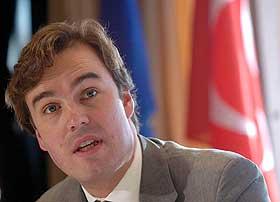
"Camiel Eurlings, a Dutch member of the Parliament's Christian Democratic group, noted in a speech in Istanbul that Turkey had been asked to improve property rights for non-Muslim minorities and take steps to improve conditions for the Greek Orthodox community to train clerics, in a European Union report issued a year ago to assess Turkish progress in meeting EU criteria for entry into the bloc.
Unfortunately, there has been little progress since this latest report. The EU Commission released its annual report on Turkey's progress in harmonization with EU standards in 2004 autumn and is due to issue the 2005 assessment on Nov. 9. The report is expected to praise Turkey's reform progress while criticizing Ankara for remaining deficiencies."
Turkish Daily News - Eurlings: Turkey has achieved little progress in religious freedoms
Thursday, October 20, 2005
Secularism allows for religious differences
"From the fall of Constantinople in 1453 and the rise of the Ottoman Empire, until its 20th century secular revolution under Mustafa Kemal aka Atatürk separated the Turkish mosque and state, Islamic authority in that country included civil, military and police powers as well as religious observance.
In the establishment of the republic in 1923, Turkey became more than a secular state. It also westernized itself by adopting the Latin alphabet in the place of Arab script, encouraging European dress, and banning the Fez."
"But secular is supposed to mean a separation of religion and state. A secular state should allow for religious differences, and by and large it does. What is at issue is mostly secular society, not religion, or its separation from the state.
If you do not have to be Christian to be French, Dutch or German, you can be an adherent to a church. You can also be Muslim, or Jewish, or practice any other religion — or you should be able to — to be a European.
So the debate over Turkey and the EU is very much a debate over what place a Western secular society accords its Islamic minority."
"Turkey is a secular society that is also almost entirely Muslim. Western societies that have Muslim minorities and want to block Turkey have to understand what is being said if that happens. If a Muslim society cannot enter Europe, then Muslims must find their future with other Muslims. In other words the world must organize itself around religion. Surely this is what the secular revolution in Europe — and in Turkey — was meant to avoid."
rabble news
In the establishment of the republic in 1923, Turkey became more than a secular state. It also westernized itself by adopting the Latin alphabet in the place of Arab script, encouraging European dress, and banning the Fez."
"But secular is supposed to mean a separation of religion and state. A secular state should allow for religious differences, and by and large it does. What is at issue is mostly secular society, not religion, or its separation from the state.
If you do not have to be Christian to be French, Dutch or German, you can be an adherent to a church. You can also be Muslim, or Jewish, or practice any other religion — or you should be able to — to be a European.
So the debate over Turkey and the EU is very much a debate over what place a Western secular society accords its Islamic minority."
"Turkey is a secular society that is also almost entirely Muslim. Western societies that have Muslim minorities and want to block Turkey have to understand what is being said if that happens. If a Muslim society cannot enter Europe, then Muslims must find their future with other Muslims. In other words the world must organize itself around religion. Surely this is what the secular revolution in Europe — and in Turkey — was meant to avoid."
rabble news
Monday, October 17, 2005
Ravi Zacharias meetings in Turkey

Thank you for praying for the outreach events last week. Ravi spoke at 3 meetings in Istanbul. Two were outreach minded and one for Christians. In the two outreach events there were about 625 in attendance! Please pray that the Gospel seeds planted will grow.
Please also pray for the Şişli Belediye. As seen in this newspaper article above, they were accused of helping missionaries. This is a political shame tactic towards the Şişli mayor. This culture center has hosted Christian events in the past and hopefully it will again.
Thursday, October 13, 2005
Is there religious freedom in Turkey?
"Go to any mosque or church in Turkey and you will see people worshipping. So clearly some religious freedom exists. Yet serious problems persist. Religious communities are not allowed to organise themselves as they choose. Individual religious freedom exists up to a point. For example, you are entitled by law to change your religion and to have the change recorded on your identity documents, but people who have done so have faced hostility from fellow-citizens. As soon as a religious community wants to organise itself, problems arise. This holds just as much for Muslims as for communities of other faiths.
Religious meetings and services without authorisation remain illegal, though it remains unclear in law what constitutes legal and illegal worship. The Ottoman millet system recognised some religious minorities and the 1923 Lausanne Treaty spoke vaguely of religious minority rights without naming them, but the Turkish authorities interpret this to exclude communities such as the Roman Catholics, Syriac Orthodox and Lutherans, even though these communities have found ways to function. Protestant Christian churches functioning quietly in non-recognised buildings are generally tolerated, but Muslims gathering outside an approved mosque are viewed as a threat to the state and police will raid them.
It is not possible for most Protestant Christian churches to be recognised as churches under current Turkish law. But in one bizarre case, a German Christian church was recognised in Antalya, but only by calling itself a "chapel" not a "church." Most Evangelical Protestant churches in Turkey do not meet in private homes, but in rented facilities such as office buildings or other non-residential buildings. These can be fairly large."
The government indicated to Protestant churches that individuals cannot ask for buildings to be designated as a place of worship, but individual congregations should try to get recognition as a legal personality first (as a "Dernek" or society) and then try to get their meeting place designated as a place of worship. At least two Protestant churches are now trying this route.
There are currently two Protestant churches that are legally recognised by the Turkish state, one of which is in Istanbul. It was recognised as a "Vakf" (charitable foundation) several years ago, after a long court battle, making it a legal entity. Several weeks ago, they finally had their building officially designated as a place of worship. The second example is the Protestant church in Diyarbakir, which has legal recognition as a house of worship under the Ministry of Culture, as a heritage site."
"All religious communities are under state surveillance, with religious minorities facing the closest scrutiny. Christian leaders know they are listened in to and their telephones are tapped. Police visit individual Christian churches to ask who attends, which foreigners have visited, what they discussed. They are particularly interested in which Turkish citizens attend."
"You have to be very courageous to set up a Protestant church in remote areas, as pastor Ahmet Guvener found in Diyarbakir. Problems can come from neighbours and from the authorities. Even if not working hand in hand, neighbours and officials share the same hostility. They cannot understand why anyone would convert to Christianity. People are not upset seeing old Christian churches – Syriac Orthodox and other Christian churches have always existed in Anatolia – but seeing a new Protestant church, even when housed in a shop or private flat, arouses hostility."
Forum 18 Search/Archive
Religious meetings and services without authorisation remain illegal, though it remains unclear in law what constitutes legal and illegal worship. The Ottoman millet system recognised some religious minorities and the 1923 Lausanne Treaty spoke vaguely of religious minority rights without naming them, but the Turkish authorities interpret this to exclude communities such as the Roman Catholics, Syriac Orthodox and Lutherans, even though these communities have found ways to function. Protestant Christian churches functioning quietly in non-recognised buildings are generally tolerated, but Muslims gathering outside an approved mosque are viewed as a threat to the state and police will raid them.
It is not possible for most Protestant Christian churches to be recognised as churches under current Turkish law. But in one bizarre case, a German Christian church was recognised in Antalya, but only by calling itself a "chapel" not a "church." Most Evangelical Protestant churches in Turkey do not meet in private homes, but in rented facilities such as office buildings or other non-residential buildings. These can be fairly large."
The government indicated to Protestant churches that individuals cannot ask for buildings to be designated as a place of worship, but individual congregations should try to get recognition as a legal personality first (as a "Dernek" or society) and then try to get their meeting place designated as a place of worship. At least two Protestant churches are now trying this route.
There are currently two Protestant churches that are legally recognised by the Turkish state, one of which is in Istanbul. It was recognised as a "Vakf" (charitable foundation) several years ago, after a long court battle, making it a legal entity. Several weeks ago, they finally had their building officially designated as a place of worship. The second example is the Protestant church in Diyarbakir, which has legal recognition as a house of worship under the Ministry of Culture, as a heritage site."
"All religious communities are under state surveillance, with religious minorities facing the closest scrutiny. Christian leaders know they are listened in to and their telephones are tapped. Police visit individual Christian churches to ask who attends, which foreigners have visited, what they discussed. They are particularly interested in which Turkish citizens attend."
"You have to be very courageous to set up a Protestant church in remote areas, as pastor Ahmet Guvener found in Diyarbakir. Problems can come from neighbours and from the authorities. Even if not working hand in hand, neighbours and officials share the same hostility. They cannot understand why anyone would convert to Christianity. People are not upset seeing old Christian churches – Syriac Orthodox and other Christian churches have always existed in Anatolia – but seeing a new Protestant church, even when housed in a shop or private flat, arouses hostility."
Forum 18 Search/Archive
Tuesday, October 11, 2005
Chinese Mission Head Reveals Vision for China to be Greatest Evangelical Nation
"A prominent international Chinese mission organisation headquartered in the United States has shared the vision for China to become “the greatest evangelical nation" during its 10th anniversary celebration in Hong Kong."
"The Back to Jerusalem movement is an 80-year-old vision of Chinese house churches to take the Gospel from China to the area known as the 10/40 Window – where Islam, Buddhism, or Hinduism are dominant and that encompasses 90 percent of the world’s unreached people."
"The general director gave support for the statement, citing some statistics. It is estimated that there are 60 million Christians in China and 1 million among them are missionaries. If just 10 percent of these missionaries join the Back to Jerusalem movement, it would mean a 100,000-strong force."
"Today, many Chinese Christians have the passion to evangelise the Middle East, according to Rev Lam. Lam has met many Chinese Christians from the province of Wenzhou in Turkey that have planted some churches in the area and are learning the local language to preach the Gospel."
Christian Today - UK & World Christian News Every Day > Chinese Mission Head Reveals Vision for China to be Greatest Evangelical Nation: "Turkey"
"The Back to Jerusalem movement is an 80-year-old vision of Chinese house churches to take the Gospel from China to the area known as the 10/40 Window – where Islam, Buddhism, or Hinduism are dominant and that encompasses 90 percent of the world’s unreached people."
"The general director gave support for the statement, citing some statistics. It is estimated that there are 60 million Christians in China and 1 million among them are missionaries. If just 10 percent of these missionaries join the Back to Jerusalem movement, it would mean a 100,000-strong force."
"Today, many Chinese Christians have the passion to evangelise the Middle East, according to Rev Lam. Lam has met many Chinese Christians from the province of Wenzhou in Turkey that have planted some churches in the area and are learning the local language to preach the Gospel."
Christian Today - UK & World Christian News Every Day > Chinese Mission Head Reveals Vision for China to be Greatest Evangelical Nation: "Turkey"
Sunday, October 02, 2005
Turkey Holds 'Meeting of Civilisations' for Religious Tolerance Amid EU-Bid Threat
"An interfaith conference was held this week by the Turkish Prime Minister in a bid to ease out the criticism over its religious intolerance, thus gaining favour for the upcoming European Union (EU) membership talk next week."
"According to the Associated Press (AP), around 2,000 Jewish, Christian and Muslim delegates attended the "Meeting of Civilisations" conference in the religiously and ethnically diverse southern city of Hatay in Turkey.
Turkey's Prime Minister Recep Tayyip Erdogan said on Sunday to the non-Muslim delegates, "Our differences are not inevitably pushing us toward a clash; they must not."
"During the conference, Christians were given the opportunity to report on the persecution they faced, according to Reuters' report on Tuesday.
Patriarch Vartholomaios, the Istanbul-based titular head of the world’s 300 million Orthodox Christians said, "We have difficulty understanding the mentality which sees our rituals as a show of force and our visits (around Turkey) as missionary activity."
"More than 99 percent of Turkey’s population follows Islam. The minority Christians are mainly descendants of Greeks and Armenians who stayed after the fall of the multiethnic, multi-confessional Ottoman Empire in the 1920s. And the Turkish Government officially recognises only three communities of religious minorities - Greek Orthodox Christians, Armenian Orthodox Christians, and Jews, according to the annual International Religious Freedom Report released by the U.S. Department of State."
Christian Today - UK & World Christian News Every Day > Turkey Holds 'Meeting of Civilisations' for Religious Tolerance Amid EU-Bid Threat
"According to the Associated Press (AP), around 2,000 Jewish, Christian and Muslim delegates attended the "Meeting of Civilisations" conference in the religiously and ethnically diverse southern city of Hatay in Turkey.
Turkey's Prime Minister Recep Tayyip Erdogan said on Sunday to the non-Muslim delegates, "Our differences are not inevitably pushing us toward a clash; they must not."
"During the conference, Christians were given the opportunity to report on the persecution they faced, according to Reuters' report on Tuesday.
Patriarch Vartholomaios, the Istanbul-based titular head of the world’s 300 million Orthodox Christians said, "We have difficulty understanding the mentality which sees our rituals as a show of force and our visits (around Turkey) as missionary activity."
"More than 99 percent of Turkey’s population follows Islam. The minority Christians are mainly descendants of Greeks and Armenians who stayed after the fall of the multiethnic, multi-confessional Ottoman Empire in the 1920s. And the Turkish Government officially recognises only three communities of religious minorities - Greek Orthodox Christians, Armenian Orthodox Christians, and Jews, according to the annual International Religious Freedom Report released by the U.S. Department of State."

Christian Today - UK & World Christian News Every Day > Turkey Holds 'Meeting of Civilisations' for Religious Tolerance Amid EU-Bid Threat
Wednesday, September 28, 2005
Human Rights Issues in Turkey Highlighted as EU Membership Talks Approach
"Ahead of the historical European Union accession talks with Turkey next month, the human rights situation of the predominantly Muslim nation has again been highlighted as a major obstacle."
"In a statement issued by the EU last December, the bloc mentioned that in Turkey, "religious freedom is subject to serious limitations as compared with European standards."
Religious freedom is often under threat in Turkey, the most populous Muslim country in Europe with very small Christian communities.
According to the 2004 International Religious Freedom Report prepared by the U.S. Department of State, 99 percent of the population in Turkey consists of Muslims. The Turkish Government officially recognizes only three communities of religious minorities - Greek Orthodox Christians, Armenian Orthodox Christians, and Jews.
Under the law, religious services may take place only in designated places of worship; only the Government can designate a place of worship; and if a religion has no legal standing in the country, it may not be eligible for a designated site. Police occasionally raid unauthorized Christian gatherings meeting in private apartments."
"In a statement issued by the EU last December, the bloc mentioned that in Turkey, "religious freedom is subject to serious limitations as compared with European standards."
Religious freedom is often under threat in Turkey, the most populous Muslim country in Europe with very small Christian communities.
According to the 2004 International Religious Freedom Report prepared by the U.S. Department of State, 99 percent of the population in Turkey consists of Muslims. The Turkish Government officially recognizes only three communities of religious minorities - Greek Orthodox Christians, Armenian Orthodox Christians, and Jews.
Under the law, religious services may take place only in designated places of worship; only the Government can designate a place of worship; and if a religion has no legal standing in the country, it may not be eligible for a designated site. Police occasionally raid unauthorized Christian gatherings meeting in private apartments."
Country of tolerance
"We often boast that Turkey is a country of tolerance. We say it is a country where the mosque of the Muslims, the church of the Christians and the synagogue of the Jews can coexist in one neighborhood of Istanbul, the cultural and business capital of the country.
"
Sometimes, however, we demonstrate in a very cruel manner our obsessions and lack of tolerance; we put aside a culture of democracy that requires one to be capable of at least listening to ideas that he may not share.
What boiled over at the Armenian conference in Istanbul during the past few days was a bitter reminder of that obsessive face of our national character, which makes many people afraid of what serious problems could indeed take place in this country if rising ultranationalism cannot be controlled."
"Tolerance cannot be defended with rotten eggs and tomatoes but with respect to differing views, arguments, beliefs and cultures.
We share the view expressed by Diyarbakır Mayor Osman Baydemir, for example, that the Turkish flag represents the entirety of citizens living in this land and their cultures. Similarly, this country belongs to all the different elements of society that together form the Turkish mosaic -- the inseparable togetherness of different colors."
"Representatives of the three monotheistic religions have come together for a conference in Hatay -- ancient Antioch -- to discuss cultures that have existed in Antioch over the ages. The representatives of the three monotheistic religions highlighted a common point: the common longing of humanity for a peaceful world and the need for mutual respect among different civilizations."
"Talking peace and commonalities but ready to accept all the differences we may have. This is the Turkey we want to live in. This is the Turkey we believe is a model country for our region and beyond."
Turkish Daily News - Country of tolerance
"
Sometimes, however, we demonstrate in a very cruel manner our obsessions and lack of tolerance; we put aside a culture of democracy that requires one to be capable of at least listening to ideas that he may not share.
What boiled over at the Armenian conference in Istanbul during the past few days was a bitter reminder of that obsessive face of our national character, which makes many people afraid of what serious problems could indeed take place in this country if rising ultranationalism cannot be controlled."
"Tolerance cannot be defended with rotten eggs and tomatoes but with respect to differing views, arguments, beliefs and cultures.
We share the view expressed by Diyarbakır Mayor Osman Baydemir, for example, that the Turkish flag represents the entirety of citizens living in this land and their cultures. Similarly, this country belongs to all the different elements of society that together form the Turkish mosaic -- the inseparable togetherness of different colors."
"Representatives of the three monotheistic religions have come together for a conference in Hatay -- ancient Antioch -- to discuss cultures that have existed in Antioch over the ages. The representatives of the three monotheistic religions highlighted a common point: the common longing of humanity for a peaceful world and the need for mutual respect among different civilizations."
"Talking peace and commonalities but ready to accept all the differences we may have. This is the Turkey we want to live in. This is the Turkey we believe is a model country for our region and beyond."
Turkish Daily News - Country of tolerance
Sunday, September 25, 2005
French Street, Istanbul
Living in Istanbul has been a whirlwind of change over the last 5 years, but perhaps the most disturbing trend has been economic disparity. The rich get richer and the poor get poorer. Prices have risen at an incredible rate. The car I bought 4 years ago sells for more than twice as much today. The average annual salary is very low, but prices for everything are quite high.
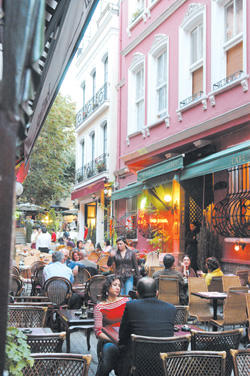
A good friend of mine grew up in one of the most popular districts of the city, Taksim. Renovations and additions like French Street, a pedestrians only street filled with exculsive cafes, drove up the prices so much they and many others had to move. There are dangerous trends towards the materialism of the west here in Turkey, but in some ways they seem worse. The division of wealth, but desire for status seem stronger than in the west. Remember to pray regularly for the Turks that they would not give in the god of Islam for the false god of "stuff". Instead, we pray that they would find them both empty and meaningless and that God would lead them to real truth.
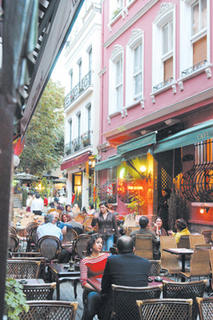
A good friend of mine grew up in one of the most popular districts of the city, Taksim. Renovations and additions like French Street, a pedestrians only street filled with exculsive cafes, drove up the prices so much they and many others had to move. There are dangerous trends towards the materialism of the west here in Turkey, but in some ways they seem worse. The division of wealth, but desire for status seem stronger than in the west. Remember to pray regularly for the Turks that they would not give in the god of Islam for the false god of "stuff". Instead, we pray that they would find them both empty and meaningless and that God would lead them to real truth.
Thursday, September 22, 2005
Turkey an Example of Religious Tolerance for 500 years
Universalism presented by an Armenian Church leader:
"Turkey is 90 percent Muslim. But in parts of the large cities, there are pockets of people of different faiths. VOA's Miguel Rivera looks at three houses of worship that share adjacent parcels in Kuzguncuk, Istanbul."
"Kuzguncuk is an ancient part of Istanbul, the only city in the world that lies in two continents: Asia and Europe. For hundreds of years its been inhabited by Muslims, Jews, and Christians; Turks, Armenians and Greeks.
Kuzguncuk lies on the Asian side of the Bosporus Strait. There is a church, a mosque, and a synagogue, right beside each other. The priest of the Armenian Orthodox Church, using a key made in 1835, opens the doors to a Christian world within a Muslim one. The priest is one of a few who come from another part of Istanbul to serve the faithful. And when he says “faithful,” he is referring to Jews and Muslims, as well as Christians, who enter this holy place to pray."
"There is no difference between us,” says priest Mehmet Biraz. ”Muslims come in here to light a candle. Yes, Muslims come to pray here. They light the candle and they pray. There is no difference. There is only one God and different paths to that God."
VOA News - Turkey an Example of Religious Tolerance for 500 years

"Turkey is 90 percent Muslim. But in parts of the large cities, there are pockets of people of different faiths. VOA's Miguel Rivera looks at three houses of worship that share adjacent parcels in Kuzguncuk, Istanbul."
"Kuzguncuk is an ancient part of Istanbul, the only city in the world that lies in two continents: Asia and Europe. For hundreds of years its been inhabited by Muslims, Jews, and Christians; Turks, Armenians and Greeks.
Kuzguncuk lies on the Asian side of the Bosporus Strait. There is a church, a mosque, and a synagogue, right beside each other. The priest of the Armenian Orthodox Church, using a key made in 1835, opens the doors to a Christian world within a Muslim one. The priest is one of a few who come from another part of Istanbul to serve the faithful. And when he says “faithful,” he is referring to Jews and Muslims, as well as Christians, who enter this holy place to pray."
"There is no difference between us,” says priest Mehmet Biraz. ”Muslims come in here to light a candle. Yes, Muslims come to pray here. They light the candle and they pray. There is no difference. There is only one God and different paths to that God."
VOA News - Turkey an Example of Religious Tolerance for 500 years

Friday, September 16, 2005
Christians disappointed: Ankara has put off the pope’s trip to Turkey
"The government fears too much publicity focused on Bartholomew I and criticism about the country’s human rights record. Nuncio Farhat: “Turkey, a nation which is an enemy of Christians”.
"The eagerly awaited invitation from the Turkish state did reach the Vatican but with a vague and diplomatic: “We expect you in Turkey for 2006”, inexonorably placating “the pangs of the pope, which have shaken the state so much”; this is how insistence on the papal visit was defined by journalist Evren Mesci on the daily Sabah. President Ahmet Necdet Sezer invited the pontiff to go to Turkey in 2006 so he “can become aware in person of the climate of cultural tolerance” which prevails in this Muslim majority country. The trip, said the spokesperson for the Foreign Affairs Ministry, Namika Tan, “will encourage efforts to intensify dialogue between religions and mutual comprehension among civilizations at global level.”
"And Bartholomew I? Publicly he bowed his head, telling journalists: “For us, it would have been a great gesture if the pope would have been able to join us to participate in our celebrations and it seems natural to us that he should be allowed to visit ‘his little brother’, but now we have lost hope, seeing that Ankara has crushed our invitation. Certainly it is not a nice situation, but we do not want to insist nor do we want to create a crisis with the State. Our leaders have judged that it is better this way and we do not want to be obstinate.”
“But why did Ankara react in this way?” journalist Deger Akal asked himself in an article published today in Vatan. “According to Turkish sources, all the eyes of the world would have been focused on Turkey during the pope’s visit; Turkey fears criticism which could arise and does not want to face upfront heavy observations like those of the Vatican Nuncio in Ankara, Edmond Farhat. “Turkey is a nation which is an enemy of Christians. It defines itself as a secular nation, but this freedom is only on paper.”
>>> AsiaNews.it <<< Christians disappointed: Ankara has put off the pope’s trip to Turkey
"The eagerly awaited invitation from the Turkish state did reach the Vatican but with a vague and diplomatic: “We expect you in Turkey for 2006”, inexonorably placating “the pangs of the pope, which have shaken the state so much”; this is how insistence on the papal visit was defined by journalist Evren Mesci on the daily Sabah. President Ahmet Necdet Sezer invited the pontiff to go to Turkey in 2006 so he “can become aware in person of the climate of cultural tolerance” which prevails in this Muslim majority country. The trip, said the spokesperson for the Foreign Affairs Ministry, Namika Tan, “will encourage efforts to intensify dialogue between religions and mutual comprehension among civilizations at global level.”
"And Bartholomew I? Publicly he bowed his head, telling journalists: “For us, it would have been a great gesture if the pope would have been able to join us to participate in our celebrations and it seems natural to us that he should be allowed to visit ‘his little brother’, but now we have lost hope, seeing that Ankara has crushed our invitation. Certainly it is not a nice situation, but we do not want to insist nor do we want to create a crisis with the State. Our leaders have judged that it is better this way and we do not want to be obstinate.”
“But why did Ankara react in this way?” journalist Deger Akal asked himself in an article published today in Vatan. “According to Turkish sources, all the eyes of the world would have been focused on Turkey during the pope’s visit; Turkey fears criticism which could arise and does not want to face upfront heavy observations like those of the Vatican Nuncio in Ankara, Edmond Farhat. “Turkey is a nation which is an enemy of Christians. It defines itself as a secular nation, but this freedom is only on paper.”
>>> AsiaNews.it <<< Christians disappointed: Ankara has put off the pope’s trip to Turkey
Saturday, September 10, 2005
Why you should visit Istanbul . . . now!
A nice little travelogue to the city we love:
"48 hours in Istanbul
Ottoman edifices, ancient mosques and all the delights of modern café society - no wonder they call this turkish city the jewel of the bosphorous."
"In the city where Europe and Asia collide, the weather is cooling off: no longer is Istanbul steamier than the average hammam, and the tourist crowds are beginning to diminish. September is the ideal month to visit Turkey's largest city, which drapes itself seductively over the shores of the Bosphorus."
Belfast Telegraph
"48 hours in Istanbul
Ottoman edifices, ancient mosques and all the delights of modern café society - no wonder they call this turkish city the jewel of the bosphorous."
"In the city where Europe and Asia collide, the weather is cooling off: no longer is Istanbul steamier than the average hammam, and the tourist crowds are beginning to diminish. September is the ideal month to visit Turkey's largest city, which drapes itself seductively over the shores of the Bosphorus."
Belfast Telegraph
Wednesday, September 07, 2005
Turkish Prime Minister urges for outlawing anti-Islamism
"At the opening session of the 6th Eurasian Islamic Council, Turkey's Prime Minister Recep Tayyip Erdogan denounced the worldwide propaganda campaign spreading the idea that Islam was in some way a source of terrorism and asserted his commitment to overcome these ideas in all the international meetings he attends.
He called on religious leaders, especialy those in Eurasia to dedicate attention and conduct organized studies on this issue, while declaring that ''problems which the Muslim world has to face can only be solved under the guidance of tradition and reason, a democratic basis and through science, experience and mutual consultation'.' Erdogan recalled the necessity to urge the European Council to adopt a wording in its declaration that accepts anti-Islamism as a crime against humanity, just as anti-Semitism has been accepted and endorsed as a crime against humanity."
Arab Monitor - Sito di informazione dal mondo arabo
He called on religious leaders, especialy those in Eurasia to dedicate attention and conduct organized studies on this issue, while declaring that ''problems which the Muslim world has to face can only be solved under the guidance of tradition and reason, a democratic basis and through science, experience and mutual consultation'.' Erdogan recalled the necessity to urge the European Council to adopt a wording in its declaration that accepts anti-Islamism as a crime against humanity, just as anti-Semitism has been accepted and endorsed as a crime against humanity."
Arab Monitor - Sito di informazione dal mondo arabo
Subscribe to:
Posts (Atom)